
Action
Adventure
Animation
Comedy
Crime
Documentary
Drama
Family
Fantasy
History
Horror
Music
Mystery
Romance
Science Fiction
Thriller
War
Western
Explore all movies appearances

Drifters tells of Karin, a past-her-prime cosmetics saleswoman, with her increasing exasperation with her life and her dreams of leaving it all behind and living in Paris. An unlikely but entertaining plot develops, where anything can happen.

The revolution is as good as over, but the captain wants to send his crew into one last battle. Before this can happen, however, he is murdered. The crew is finally free. Meanwhile, the revolutionary Snow White has hidden on the ship, but she is discovered.

Barrage and Bunker is an essay film about the (narrative) space imagined by fiction films. Reflections and associations about movement in space are the basis of every kind of story-telling. The film is sometimes referred to as part of Bitomsky's Cinema Trilogy. Sequences from over 20 movies are quoted and commented on by a team of three "researchers" (Bitomsky, Petzold, Tanner) in a sort of laboratory. TV-monitors, production stills and screenshots are used as well as quotations from books. A long night's work.
Sophie, fourteen years old, rides her bike to a remote area after school to read a book about the holocaust. She collides with Joseph, who is the same age, on her bike, and their paths become intertwined. A pile of paving stones next to a bunker triggers an idea: they want to dedicate a stone to each person murdered by the Nazis.
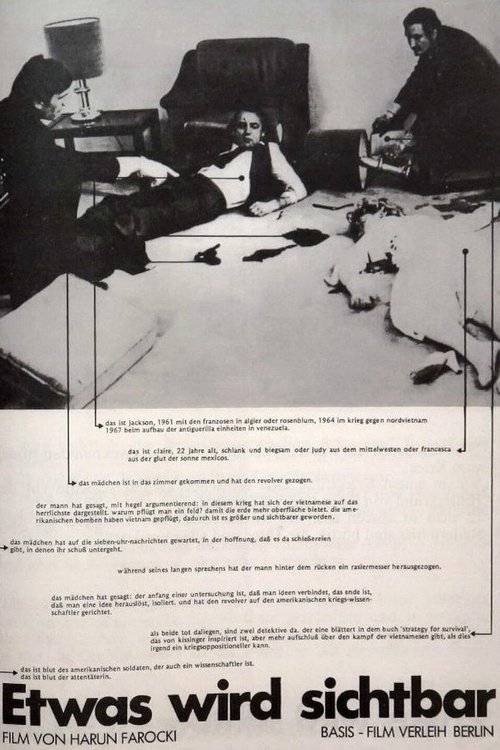
Before Your Eyes – Vietnam (1982) is an unconventional essay film by Harun Farocki that interrogates the visual and ideological legacy of the Vietnam War. Blending staged scenes, archival footage, photographs, and philosophical dialogue, the film follows various characters — including an American soldier captured by North Vietnamese villagers — as they reflect on violence, memory, and image-making. Set partly in West Berlin and partly in reconstructed spaces representing Vietnam, the film avoids traditional dramatic narrative in favor of a fragmented montage of voices, documents, and reenactments. Interweaving love stories, political debate, and historical commentary, Farocki creates a critical reflection on how war is represented, seen, and imagined, both in cinema and in public consciousness. The result is a complex meditation on images as weapons and instruments of perception.

Mondo Cane and the Schoolgirl Report series stand as obvious influences on this occasionally amusing but generally rather tedious exploitation film that alternates between documentary, fake documentary and docudrama. The theme is Satanism and the linking thread is a recreation of what is supposedly the real-life case of a murder and attempted murder of two Munich teenage men by a quartet of girls who had been dabbling in devil worship. During the ensuing trial, the lawyer resorts to dilatory tactics while the hearing is frequently interrupted by the girls breaking into incantation, temper tantrums or shivery fits ostensibly bearing on demonic possession. When the subject of the Manson killings is brought up, the most obnoxious of the defendants breaks in indignantly, claiming that Sharon Tate’s “execution” was justified as she posed dangers to the Satanic community.

Edda Chiemnyjewski, a freelance press photographer and single mother living in 1970s West Berlin, is confronted with the fact that "a cook has no time for affairs of state". She also fails to find a market for the project she has been working on with her women′s photography group that seeks to document the city. While from today′s perspective the city, which becomes one of the film′s protagonists, looks like post-war Berlin, little has actually changed as regards the precarious existence of free-lancers. With a heavy dose of self-irony Helke Sander, who also plays the leading role, tells of a divided life in a divided city.
Subscribe for exclusive insights on movies, TV shows, and games! Get top picks, fascinating facts, in-depth analysis, and more delivered straight to your inbox.