
Action
Adventure
Animation
Comedy
Crime
Documentary
Drama
Family
Fantasy
History
Horror
Music
Mystery
Romance
Science Fiction
Thriller
War
Western
Explore all movies appearances

A fragment of a short comedy of Neapolitan setting, in which the actor Vincenzo Scarpetta, son of playwright Eduardo, is struggling with a Miss across the Atlantic. The woman throws a chest in the sea, asking his lover to recover it as proof of love. He turns to a fisherman, offering him money to complete the recovery for him. The film, shot in 1916, was, for reasons unknown, unpublished until 1918.
It all begins when Nirka takes the daughter she has had by Prince Rodolpho and hands her to a confederate. He in turn hands her over to a hag, who first torments her, and later abandons her to an orphanage.
Story of a horse of the Italian army in Libya called Rataplan, wounded, treated and then shipped to Italy where is sold to a Coachman.

A man promises money to his son if he marries the woman of his choosing. The son (comically) presents his love interest as a doll to convince his father that she is the one he should marry.
Bess is busy reading a book when her folks come in and command her to spend more time at work. They give her a ball of yarn, a crochet needle and set her to work. She is left alone and while moving around in her chair she loses track of the ball of yarn. It happens to have been caught in her belt at her back and out of her own view. Being a girl of quick temper and strong in athletics, the home is in so much of a turmoil when her parents return that Bess has not been subjected to work since. (Moving Picture World)
Kri Kri can't have the girl he loves, so he fakes suicide.
The Black Circle is a Italian film from the Celio Film company.
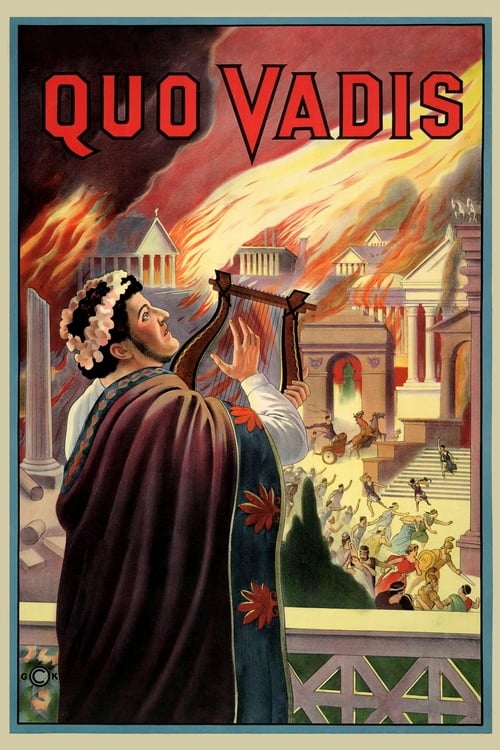
During the latter years of the reign of the tyrannical Roman emperor Nero, Marcus Vinicius, one of Nero's officers, falls in love with a young Christian named Lygia, attempting to enslave her. Lygia's protector, the noble and burly Ursus, works to save her from Vinicius' clutches. Pursuing Lygia, Vinicius finds himself at a catacomb prayer meeting led by the apostle Peter and finds his conscience stirring-- just as Nero orders Rome burned. A landmark in epic film, Enrico Guazzoni’s grand-scale masterpiece laid the foundations for what colossal Italian spectacles would become. The film had tremendous influence on Giovanni Pastrone’s Cabiria (1914) and D.W. Griffith’s Intolerance (1916).
No plot available for this movie.
Italian silent western.
Subscribe for exclusive insights on movies, TV shows, and games! Get top picks, fascinating facts, in-depth analysis, and more delivered straight to your inbox.
