
Action
Adventure
Animation
Comedy
Crime
Documentary
Drama
Family
Fantasy
History
Horror
Music
Mystery
Romance
Science Fiction
Thriller
War
Western
Explore all movies appearances

Two part movie about Einstein's escape from Germany in 1932 and his influence in the invention of the nuclear bomb in 1939.
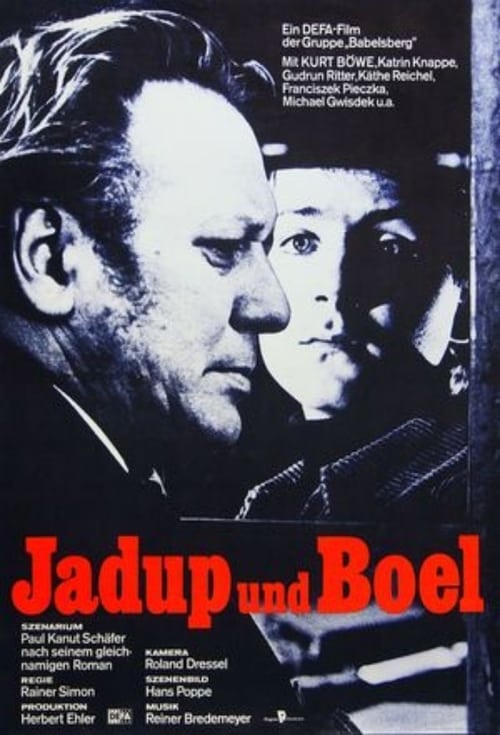
In a small town, everyone has tried to forget what happened shortly after WWII. That is, until a stranger finds a book that Jadup (Kurt Böwe) gave to the young refugee Boel (Katrin Knappe), who resettled in the town over 30 years ago. Painful memories about Boel and the post-war period begin to surface and shake up the whole town. Boel vanished back then and nobody knew why. Word spread about a rape and some tried to blame a Russian soldier. Jadup, the town's respected and popular mayor, remembers, though, how he mistrusted Boel and did not help her through this difficult time; HE didn't even notice THAT Boel loved him. Jadup's confrontation with the past gives him a new, critical view of his current situation and surroundings.

This elaborate two-part television film features a section from the life of communist worker leader Ernst Thälmann. It begins with the bloody riots on May 1, 1929 in Berlin, in which police officers shot at demonstrating workers, and ends with February 7, 1933, when Thälmann appeared as a speaker at the illegal meeting of the Central Committee of the Communist Party of Germany in goat neck. This period was marked by the struggle of the Communists against the ever stronger National Socialists and the rise of Adolf Hitler.

The three athletes Holger, Jens, and Ralf are fighting in the Nordic combined for a place in the junior national team. What has begun as fruitful team work in the children and youth sport schools, develops into a strong rivalry among the young men. Each of them excels at only one of the sports - Jens is a brilliant cross-country skier, but a bad ski jumper, and with Holger it is the other way around - thus, they need each other, yet they still fight against each other.
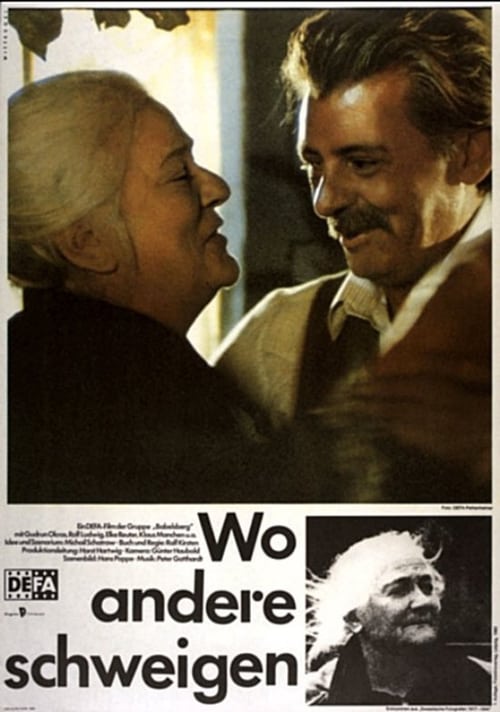
Ten days in the life of socialist politician Clara Zetkin. In August 1932, she is summoned from Archangelskoje near Moskow to open the new legislative session because at seventy-five, she is the oldest representative in the German Reichstag. Although she is ill and almost blind, she see this as her chance to make her voice heard amid the growing Nazi influence in Germany.
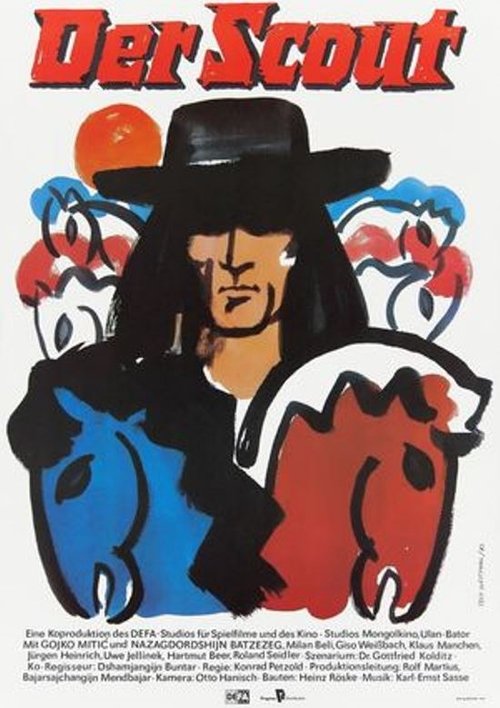
1877, the tribe of the Nez Percés Indians are driven into the reservation by a white cavalry force. So that they can not escape, their horses are requisitioned. Sub-chief "White Feather" has no choice but to make a scout with the cavalry and retrieve the stolen horses through his life.

1982: East German actor Erwin Gregorek travels to Hamburg to shoot screen tests for a film about the sinking of the ocean-liner Cap Arcona in 1945 - a catastrophe he himself survived as a concentration camp prisoner.

Ten-year-old Frantisek is traveling to Leipzig to visit his German friend Egon. On the train, he shares the compartment with three men. One of them, the bearded, hefty Blasius is polite but at times acts very confused. At the end station the two boys meet, but they must first of all get rid of Blasius, who lifts them up together with their luggage and carries them away. Leipzig is packed with tourists who have gathered for the famous Fair. The eccentric bearded fellow deals effectively with the traffic jam in front of the station. Blasius's fellow travelers from the train - inventors Prantl and Pirwitz, are at the fairground, boasting of their new invention and claiming it to be the greatest surprise of the entire Fair.

Suse works as a truck driver on a major construction site. The young woman has a hard life behind her. She was foundling, was raised by farmers. Manne, the father of her child, wanted to escape from the GDR and is in prison. After he is released, Manne wants to live again with Suse and their child together. But she rejects him as well as another worshiper. Suse is more interested in the Soviet engineer Boris, but apparently not for her, since he can never remember her at their chance encounters. But a much bigger problem - and a difficult one - is Suse, when she is offered to go to the Soviet Union for six months.

Episodes from the life of German poet and communist Erich Weiner: his stay in Paris, participation in the Spanish Civil War, years of exile in Russia. Moscow, May 1941. Children play in the sun, young people fall in love, make plans for their future. German emigrants, including 50-year-old Erich, are concerned about events in their homeland and sense impending disaster...
Subscribe for exclusive insights on movies, TV shows, and games! Get top picks, fascinating facts, in-depth analysis, and more delivered straight to your inbox.
