
Action
Adventure
Animation
Comedy
Crime
Documentary
Drama
Family
Fantasy
History
Horror
Music
Mystery
Romance
Science Fiction
Thriller
War
Western
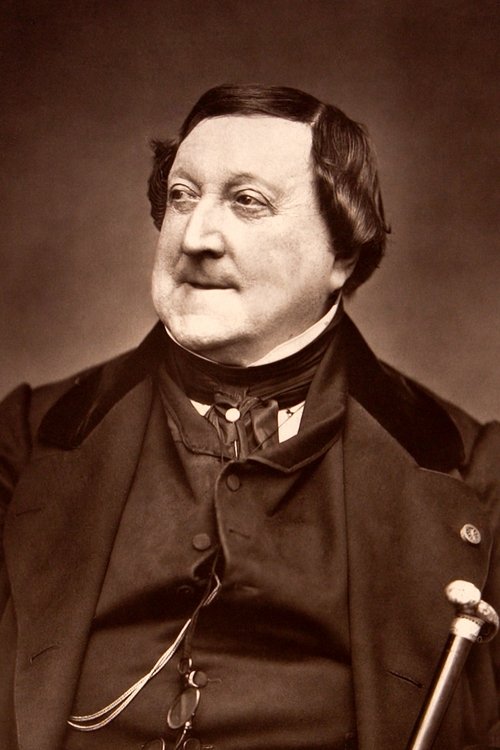
Gioachino Antonio Rossini was an Italian composer who gained fame for his 39 operas, although he also wrote many songs, some chamber music and piano pieces, and some sacred music. He set new standards for both comic and serious opera before retiring from large-scale composition while still in his thirties, at the height of his popularity. Rossini began to compose by the age of 12 and was educated...
Explore all movies appearances

In this fifth episode of the series, La torta di Guglielmo, Rossini, is “interviewed” by Gaia de Bernardis, presenting, this time, the cake that gives the clip its title: an apple pie, with cream, sugar, flour and butter. Together with the composer, musicologist Alberto Simoncini and the ever-present Stendhal. Of course, it follows from the title that the opera presented along with the dessert is William Tell, whose libretto was taken from the play of the same name (1804) by Friedrich Schiller, later elaborated by Victor-Joseph-Étienne de Jouy and Hippolyte-Louis-Florent Bis. Its first performance took place at the Paris Opéra on August 3, 1829.
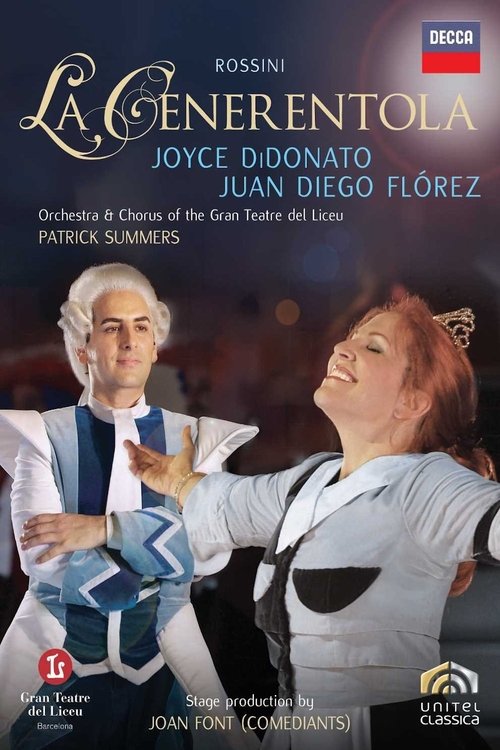
This is an excellent version of one of the greatest of all comic operas, featuring superb singing and orchestral playing. And it's not just the two headliners; listen, for example, to the entrance of the stepsisters at the beginning of Act One. Nevertheless, some viewers may find the staging problematic, with singers in clown-like costumes and sets featuring human-sized rodents. Those seeking a more conventional production might want to consider the Houston Grand Opera DVD, also on Decca, with Cecilia Bartoli and Raul Jimenez. Both sets are wonderful, but, for me, Joyce Didonato and Juan Diego Florez are slightly to be preferred. Highly recommended.

LA PIETRA DEL PARAGONE (The Touchstone) concerns the Count Asdrubale who is wealthy and therefore of great interest to many women – notably Aspasia, Fulvia, and Clarice. Only Clarice, however, loves him for something other than his riches. There are also male hangers-on: the corrupt journalist Macrobio, the poetaster Pacuvio, and Giocondo, who is Asdrubale's true friend, but who has his own eyes on Clarice. To test his friends and would-be fiancées, Asdrubale pretends that he has been bankrupted. Sure enough, only Clarice and Giocondo stand by him, and when his fortune is "miraculously" saved, the three have the last laugh on everyone else... or do they? This production is set in what looks like the early 1960s. But the real innovation is the use of blue screen technology: using tiny cameras and sets, along gigantic screens hanging over the stage, a kind of video mixing makes the singers appear to inhabit any number of fanciful settings and perform a myriad of improbable actions.
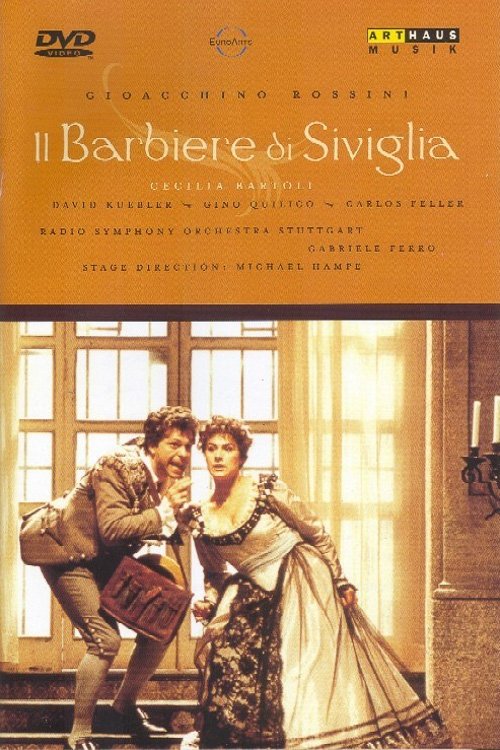
Live performance from Schwetzinger Festspiele, 1988. What sets this IL BARBIERE DI SIVIGLIA apart from all others available is its elegant realism. None of its visuals are the least bit cartoonish or blatantly designed for comedy. Dr. Bartolo’s house is a stark, stern-looking structure of plastered brick with a comfortable yet plain, white-curtained interior, while the costumes are highly realistic 18th century garb in subdued colors. Yet despite its fairly austere appearance the production is delightful, thanks to its performers and staging. The stage business is lively, witty and free of excessive slapstick, and every singer brings his or her character to life, all offering rich, vibrant characterizations that strike a perfect balance between comedy and humanity.
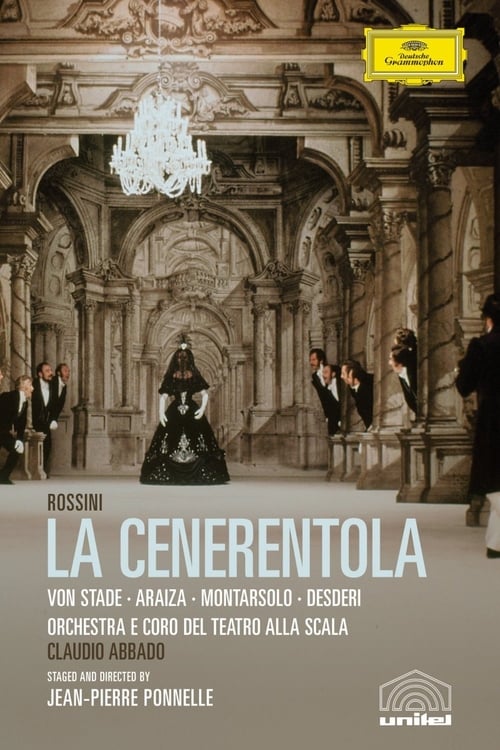
The Prince, Don Ramiro (who has changed places with his valet, Dandini), meets Cenerentola and they are instantly attracted to each other. When the Philosopher, Alidoro, later takes Cenerentola (dressed in magnificent clothing) to the palace, Dandini (still posing as the prince) tries to talk of love to her, but Cenerentola rejects him, saying that she is in love with his 'valet'. Ramiro, who has overheard this comment, is overjoyed, and immediately proposes to her, but Cenerentola says that he must first seek her out and then, if he still felt the same way, she would marry him. She gives him one of a matching pairs of bracelets, telling him to look for its companion on her right arm (she then leaves the palace). Ramiro ends the masquerade, and he and Dandini resume their true identities. The Prince then sets out on his quest - little realising that destiny, in the form of a violent thunderstorm, is about to take a hand in the affair.
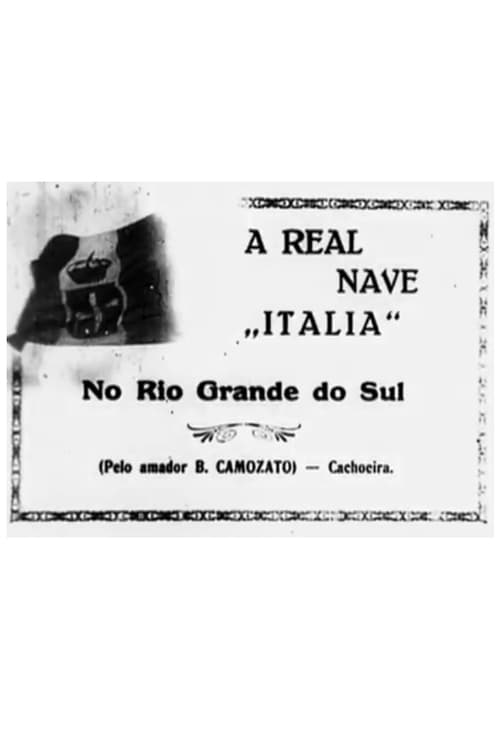
Photograph of King Vittorio Emanuele III. The ship Italia, formerly König Albert, under the command of Count Carlos Grenet and with the Italian ambassador Giovanni Giuriati, entering the port of Rio Grande, on May 2: events and groups of Italian reservists for their reception; popular and authorities, representatives of societies and the cities of Cachoeiro and Pelotas, music band, including a representative of the fascism of Caxias, present at the reception.
Subscribe for exclusive insights on movies, TV shows, and games! Get top picks, fascinating facts, in-depth analysis, and more delivered straight to your inbox.