
Action
Adventure
Animation
Comedy
Crime
Documentary
Drama
Family
Fantasy
History
Horror
Music
Mystery
Romance
Science Fiction
Thriller
War
Western
Found 36 movies, 6 TV shows, and 4 people
Can't find what you're looking for?

A teenage girl describes the clash with bureaucracy and housing perturbations her parents experienced.

A young man calls a girl to arrange a meeting, but the girl doubts his feelings because of his unfortunate choice of words.

No description available for this movie.
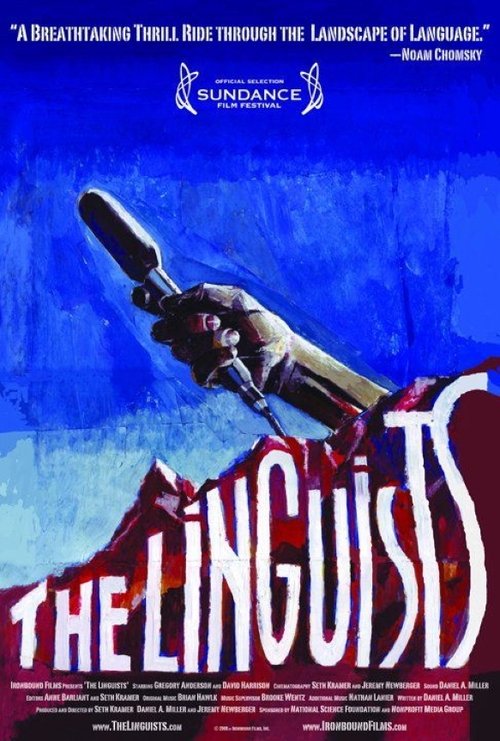
The Linguists is a hilarious and poignant chronicle of two scientists—David Harrison and Gregory Anderson—racing to document languages on the verge of extinction. In Siberia, India, and Bolivia, the linguists confront head-on the very forces silencing languages: racism, humiliation, and violent economic unrest. David and Greg's journey takes them deep into the heart of the cultures, knowledge, and communities at risk when a language dies.
No description available for this movie.
The work’s images appear as visualizations of electronically generated sounds. Initially, small pulsating pixel structures occasionally appear on the black screen. These monadic forms become larger, ultimately filling the picture plane and pulsating ever more intensely.

Two conspiracy theorists enlist the aid of an expert to interpret some confidential information.
Linguists investigate why some languages become global and others disappear and how language and identity are connected. They also discuss the state and fate of Livonian, Dogon, Mlabri, Changsha Hua, Naqxi, Pitjantjatjara, Pintupi, and Tutunaku

Round table on the teaching of secondary school.

Explaining the story behind the most interesting linguistic theories, artifacts, and languages. This completes the cognitive science iceberg trilogy alongside my philosophy and psychology icebergs.
Inspired by Láadan, the constructed ‘women’s language’, developed by Suzette Haden Elgin in her sci- fi trilogy ‘Native Tongue’ (1984-94).
Two friends talk about art and movies A deaf couple next to them talk about love and religion

Julia Kristeva’s background in psychoanalysis is central to her intellectual work, as she trained in Freudian and Lacanian theory after moving to France in the 1960s. Drawing on this training, she connects language to the unconscious, emotion, and the formation of the self, arguing that linguistic structures both reveal and shape our deepest psychological processes.

Taking place after alien crafts land around the world, an expert linguist is recruited by the military to determine whether they come in peace or are a threat.

A snobbish phonetics professor agrees to a wager that he can take a flower girl and make her presentable in high society.

A film about the noted American linguist/political dissident and his warning about corporate media's role in modern propaganda.

From the team behind Man on Wire comes the story of Nim, the chimpanzee who in the 1970s became the focus of a landmark experiment which aimed to show that an ape could learn to communicate with language if raised and nurtured like a human child. Following Nim's extraordinary journey through human society, and the enduring impact he makes on the people he meets along the way, the film is an unflinching and unsentimental biography of an animal we tried to make human. What we learn about his true nature - and indeed our own - is comic, revealing and profoundly unsettling.

This series comprised six lectures on music, which cumulatively took the title of a work by Charles Ives, The Unanswered Question. Bernstein drew analogies to other disciplines, such as poetry, aesthetics, and especially linguistics, hoping to make these lectures accessible to an audience with limited or no musical experience, while maintaining an intelligent level of discourse: Phonology is the linguistic study of sounds, or phonemes. Bernstein's application of this term to music results in what he calls "musical phonology".

A series of interviews featuring linguist, philosopher and activist Noam Chomsky done in hand-drawn animation.
This series comprised six lectures on music, which cumulatively took the title of a work by Charles Ives, The Unanswered Question. Bernstein drew analogies to other disciplines, such as poetry, aesthetics, and especially linguistics, hoping to make these lectures accessible to an audience with limited or no musical experience, while maintaining an intelligent level of discourse: This lecture takes its name from a line in John Keats' poem, "On the Grasshopper and Cricket". Bernstein does not discuss Keats' poem directly in this chapter, but he provides his own definition of the poetry of earth, which is tonality. Tonality is the poetry of earth because of the phonological universals discussed in lecture 1. This lecture discusses predominantly Stravinsky, whom Bernstein considers the poet of earth.

This award winning film is a fast paced, humorous look at the colorful way the residents of New Orleans express themselves - why they talk the way they do, where the words come from, and what it means to talk with a New Orleans accent.
This series comprised six lectures on music, which cumulatively took the title of a work by Charles Ives, The Unanswered Question. Bernstein drew analogies to other disciplines, such as poetry, aesthetics, and especially linguistics, hoping to make these lectures accessible to an audience with limited or no musical experience, while maintaining an intelligent level of discourse:Semantics is the study of meaning in language, and Bernstein's third lecture, "musical semantics", accordingly, is Bernstein's first attempt to explain meaning in music. Although Bernstein defines musical semantics as "meaning, both musical and extramusical" this lecture focuses exclusively on the "musical" version of meaning.

Based on the lives of activists and students who participated in the 1965 Anti-Hindi Imposition Movement.
This series comprised six lectures on music, which cumulatively took the title of a work by Charles Ives, The Unanswered Question. Bernstein drew analogies to other disciplines, such as poetry, aesthetics, and especially linguistics, hoping to make these lectures accessible to an audience with limited or no musical experience, while maintaining an intelligent level of discourse: Bernstein provides two distinct meanings of the term ambiguity. The first is "doubtful or uncertain" and the second, "capable of being understood in two or more possible senses"

Evan Birch is a family man and esteemed professor at a distinguished university. When a female student goes missing, police Detective Malloy has reason to be suspicious when crucial evidence makes Evan the prime suspect in her disappearance.
This series comprised six lectures on music, which cumulatively took the title of a work by Charles Ives, The Unanswered Question. Bernstein drew analogies to other disciplines, such as poetry, aesthetics, and especially linguistics, hoping to make these lectures accessible to an audience with limited or no musical experience, while maintaining an intelligent level of discourse: Lecture 5 picks up at the early twentieth century with an oncoming crisis in Western Music. As these lectures have traced the gradual increase and oversaturation of ambiguity, Bernstein now designates a point in history that took ambiguity too far.
This series comprised six lectures on music, which cumulatively took the title of a work by Charles Ives, The Unanswered Question. Bernstein drew analogies to other disciplines, such as poetry, aesthetics, and especially linguistics, hoping to make these lectures accessible to an audience with limited or no musical experience, while maintaining an intelligent level of discourse: Syntax refers to the study of the structural organization of a sentence, or as Bernstein summarizes, "the actual structures that arise from that phonological stuff."
Marc Okrand discusses his involvement with the Star Trek franchise and his work on inventing the Klingon and Vulcan languages.

An indigenous language is in peril, as its last two speakers had a quarrel in the past and haven't spoken to each other in over 50 years. Martín, a young linguist, will undertake the challenge of bringing the old friends back together and convincing them to speak once again so he can obtain a recorded registration of the language and study it.

A dramatized biography of William Tyndale, the 16th Century reformer determined to translate the Bible into English, which illegal act set him at odds with the Catholic Church, Sir Thomas More and King Henry VIII.

The Grammar Of Happiness follows the story of Daniel Everett among the extraordinary 'nonconvertible' Amazonian Pirah tribe, a group of indigenous hunter- gatherers whose culture and outlook on life has taken the world of linguistics by storm. As a young ambitious missionary three decades ago, Dan, a red-bearded towering American, decamped to the Amazon rain forest to save indigenous souls. His assignment was to translate the book of Mark into the tongue of the Pirah, a people whose puzzling speech seemed unrelated to any other on Earth. What he learned during his time with the Pirah led him to question the very foundations of his own deep beliefs. As a 'born again' atheist, Dan divorced his devout Christian wife and became estranged from his children. Having lost faith and family, his new life is dominated by the desire to leave behind his legacy. Everett's most controversial claim is that the Pirah language lacks 'recursion' - the ability to build an infinite number of sentences.
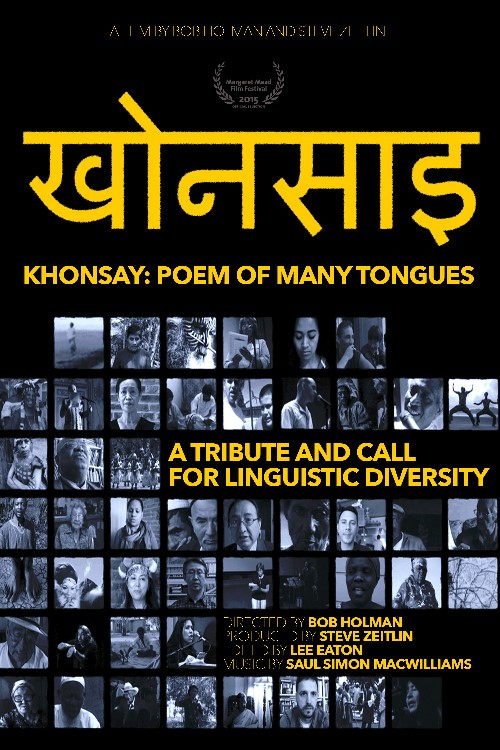
A tribute and call to action for linguistic diversity. A 15-minute motion poem (poem on film), each line comes from a different treasure or minority language. 48 speakers each speak in their mother tongues, as line by line, language by language, the poem is created.

An in-depth look at the work and views of the man described as 'one of the greatest minds in human history'. He first emerged through his pioneering work in linguistics in the 1950s but later became a political activist and a critic of US foreign policy in Vietnam, its neo-liberal capitalism, and mainstream media. Consisting primarily of interviews with Chomsky and other writers, academics, philosophers, social commentators and broadcasters, this film explores the breadth, originality and importance of his work; and the alternative narratives he has advanced at some of the most critical periods in recent history.

The two girls decided to do their daily prayers in the school, but turns out one of them accidentally fell asleep instead. But when she woke up, she felt uneasy with her friend that's undergoing the prayer without her.

After the events of Humuq 1: Do Not Sleep at Dusk, a new main character called Aurora appears to try & save Ling-ling from the danger she's in. But then as time goes, she slowly discovers secrets that lies within her surroundings.

Two souls: One seeks to know her life's true essence and the other is haunted by foreign sights of himself, as they both are influenced by an existence beyond human realm—whom continually oversees them across eras, trapping them in a game of time and the unknown.