
Action
Adventure
Animation
Comedy
Crime
Documentary
Drama
Family
Fantasy
History
Horror
Music
Mystery
Romance
Science Fiction
Thriller
War
Western
Found 21 movies, 2 TV shows, and 0 people
Can't find what you're looking for?

In 1980, six students from UNAM embarked on the first Mexican expedition to the Himalayas, aiming to conquer Mount Kanchenjunga West, also known as Yalung Kang. Despite the lack of national interest in mountaineering and minimal media coverage, these young pioneers sought to achieve a remarkable feat for Mexico by scaling an eight-thousand-meter peak, demonstrating courage and determination in the face of societal indifference.

Many mountaineers as part of their activity have used cameras and films to allow us to participate through images in their adventures and their emotions. Many of them have become true film professionals: Joseph Vallot, Lionel Terray, Marcel Ichac, Renè Vernadet, Jean Afanasieff, Pierre Royer, Denis Ducroz, Kurt Diemberg and many others are among the conquerors of the image of the mountain. The film depicts the passion of these men on the highest mountains in the world... behind the lens.
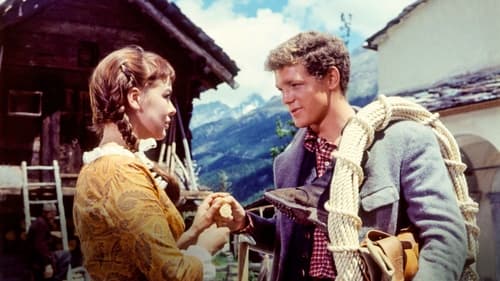
Famous British mountaineer Winter wants to climb a difficult summit, the Citadel. He goes to a small village but no guide wants to accompany him. A young man from the village, Rudi Matt, whose father died fifteen years earlier during an attempt to climb the Citadel, is determined to accompany him, with the help of his uncle. Winter also manages to hire a guide from a neighboring village and competitor, Emil Saxo. The roped party of four men then begins the ascent of the still untouched summit.
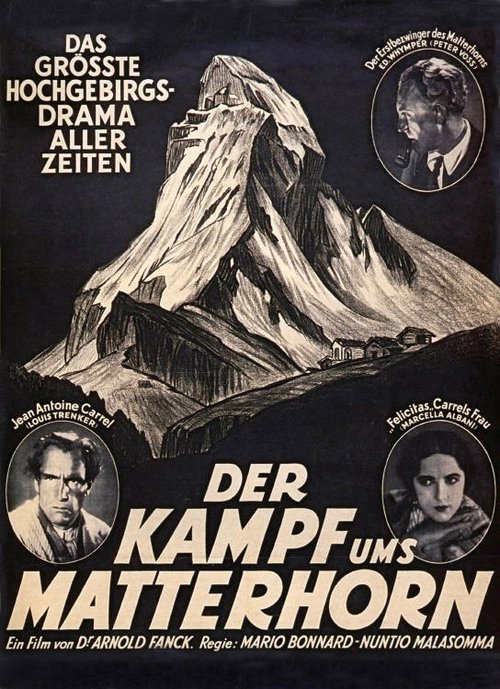
Struggle for the Matterhorn (German: Der Kampf ums Matterhorn) is a 1928 German-Swiss silent drama film co-directed by Mario Bonnard and Nunzio Malasomma and starring Luis Trenker, Marcella Albani, and Alexandra Schmitt. The film is part of the popular cycle of mountain films of the 1920s and 1930s. Art direction was by Heinrich Richter. Based on a novel by Carl Haensel, the film depicts the battle between British and Italian climbers to be the first to climb the Matterhorn. Trenker later remade the film as The Challenge in 1938.
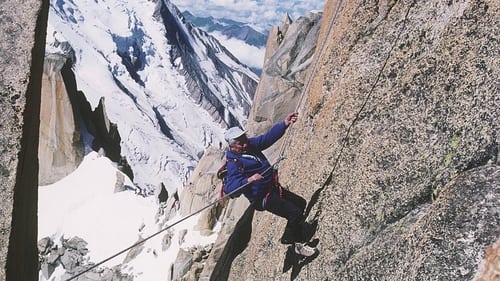
July 1956: like every summer, the actor and cellist Maurice Baquet temporarily deserts the stage and the cinema studios to go to Chamonix where the mountaineer Gaston Rebuffat is waiting for him. A few days later, the two men achieved a historic first, that of the south face of the Aiguille du Midi (3,842 m), a magnificent wall rising like a rampart above the Vallée Blanche. July 1988: to pay tribute to the memory of his friend Gaston, now deceased, Maurice Baquet once again climbed this wall suspended between heaven and earth with the man who, 50 years his junior, is considered one of his best contemporary mountaineers: Christophe Profit.

Paragot and Bérardini: two climbers who fill all climbing enthusiasts with admiration. In Fontainebleau, Saussois, the Alps, the Andes, the Himalayas, and all over the world, they have left their names attached to the most difficult routes and the most prestigious peaks. Here, they recount only the climbs they completed together: famous expeditions to Aconcagua and Huascarán, firsts in the Alps and the Dolomites. An unwavering friendship, comical and tragic adventures—this is what they share with us in the warm atmosphere of their memories. "La Cordée des Voyous" will be included in Jean Afanassieff's film "La Grande Cordée," which deals with post-war proletarian mountaineering.

The "Lyon Premier 8000-Gasherbrum II 8035m" expedition, organized and led by Jean-Pierre Frésafond in 1975, was sponsored by the Lyon section of the Club Alpin Français and by Louis Pradel, Mayor of Lyon. The film traces the departure from Lyon of Berliet heavy trucks loaded with equipment, daily life in Pakistan, preparation for the expedition and the approach march with the porters, daily life at the base camp and in the camps. altitude of the members of the expedition: L. Audoubert, Marc Batard, F. Bourbousson, A. Chariglione, J. Dupraz, J.J. Forrat, H. and JP. Frésafond, B. Macho, Doctor A. Raymond, Y. Seigneur, J. Soubis, F. Valençot, B. Villaret de Chauvignypuis. Finally On June 18, 1975, Yannick Seigneur and Marc Batard reached the summit by opening a route along the south ridge. Bernard Villaret de Chauvigny, who was killed during the second assault, was the first victim of the Gasherbrum.
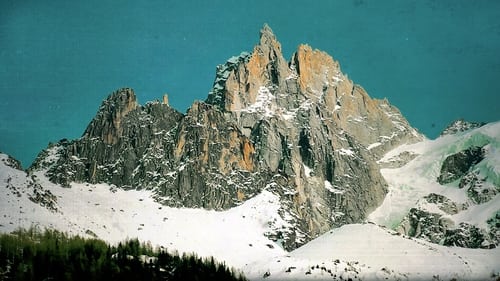
"Sur Les Traces De Premier De Cordée", a color documentary from 1952 which will be released the same year as the eponymous photo book published by Arthaud, features Roger Frison-Roche and his sidekick Georges Tairraz II on the Aiguille du Grépon (3482 m) in the Aiguilles massif which overlooks the Chamonix valley. Together they co-produce the images of the ascent. The young Pierre Tairraz, who completed his training in Paris, at the school in the rue de Vaugirard (Cinema promotion in 1953), also took part in this very technical aerial filming as assistant to his father Georges Tairraz II and cameraman.
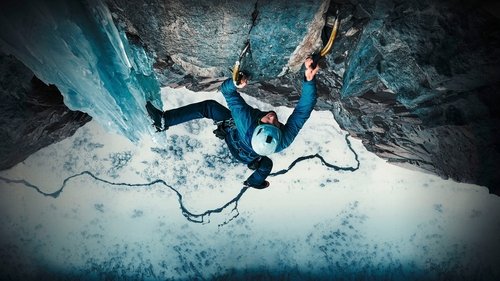
Marc-André Leclerc, an exceptional climber, has made solo his religion and ice his homeland. When filmmaker Peter Mortimer begins his film, he places his camera at the base of a British Columbia cliff and waits patiently for the star climber to come down to answer his questions. Marc André, a little uncomfortable, prefers to return to the depths of the forest where he lives in a tent with his girlfriend Brette Harrington. In the heart of winter, Peter films vertiginous solos on fragile ice. He tries to make appointments with the climber who is never there and does not seem really concerned by this camera pointed at him "For me, it would not be a solo if there was someone else" . Marc-André is thus, the "pure light" of the mountaineers of his time, which marvel Barry Blanchard, Alex Honnold or Reinhold Messner, interviewed in the film. An event film for an extraordinary character.
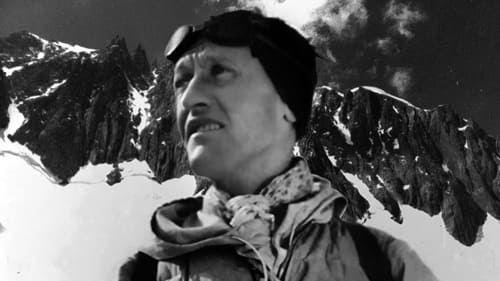
Marcel Ichac accompanied the mountaineer Armand Charlet, in 1943, in the repetition of the first crossing of the Aiguilles du Diable that the guide of the Chamonix valley had made in 1925. A roped party joined on snow and ice the Col du Géant, reached at the Mont-Blanc-du-Tacul stop and on the Col du Diable. The men cross the needles by climbing chimneys, cracks and abseiling walls. They access the eastern slope of the Mont-Blanc massif which offers a panorama of the Grandes Jorasses and Mont-Blanc. Armand Charlet was the first to reach the summits of four needles above 4000 meters: the Devil's Horn, Pointe Chaubert, Pointe Médiane and Pointe Carmen; he also tells how he successfully climbed the furthest, the Isolated. Marcel Ichac shot these scenes as close as possible to his subject, he responded with this film with a “truth” cinema, the principle of which we find in his later productions.
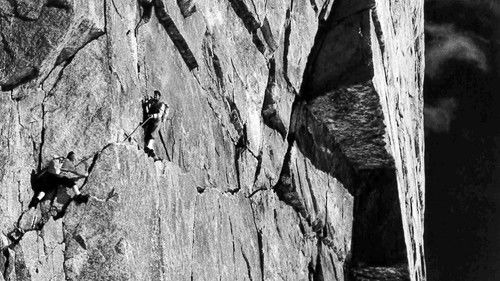
This is Gaston Rebuffat's fourth film, in which, with several close friends, he discovers the sublime landscapes of the Alps. “Mont-Blanc is beautiful. I climbed it several times depending on the time, the color of the sky and the shape of the cornices and ridges. Because of the weather and also because of this feeling of altitude, Mont-Blanc provides great pleasure. For the guide, Mont Blanc is his garden, but the garden becomes more beautiful when shown to a friend. Personally, I really like the bivouacs; only there one penetrates a little the mystery of the altitude. That's why I immediately accepted when Tazieff expressed the desire to spend the night at the top of Mont Blanc in an igloo. The film won the Grand Prix at the Trento Film Festival in 1961.

No description available for this movie.
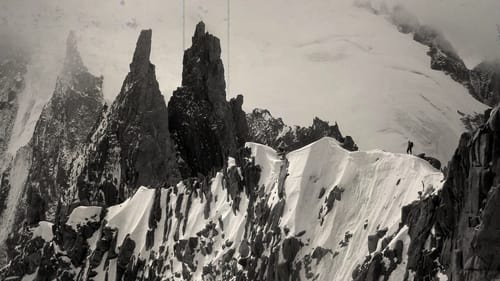
"The ascent of the Aiguilles Ravanel and Mummery", climbed by young guides in cycling pants: The brothers Armand Charlet and Georges Charlet, Arthur Ravanel, Henri Couttet and Charles Balmat. The film was shot by Georges Tairraz II, Chamoniard mountain photographer, representative of the third generation of a family line of mountain photographers and filmmakers. George Tairraz II's film will lay the groundwork for a French vision of mountain film; In the 1930s, a French school of mountain cinema emerged, less expressionist, more stripped down and realistic than the German school. These are the films of Marcel Ichac, Roger Frison-Roche, Samivel, Georges Tairraz II, etc. It develops according to the principles set by Marcel Ichac, in opposition to the German school. It is both about getting out of the dramatic vision of the mountain and placing the mountain and the climbers at the heart of the plot.
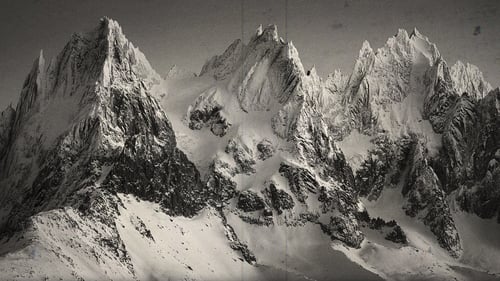
L'Appel Des Cimes, directed by Alain Pol, is a documentary commissioned by the CAF and the various French ministries on the practice of post-war mountaineering. In 1946, climbers trained at the Fontainebleau Climbing School. Guy Poulet and Jacques Poincenot try to climb the Aiguilles de Chamonix but fail during the climbing phase. After a night in a refuge with Denise Rouzeau and the guide Pierre Allain, the mountaineers make a new attempt. Successful demonstration for those who continued the approach walk then the passage of the seracs of the glacier. On the rock, the roped party crosses a chimney and a crack to reach the summit and abseil down. Led by high mountain scouts, Guy and Jacques rediscover the glaciers and needles of the Mont-Blanc massif during the next lesson.
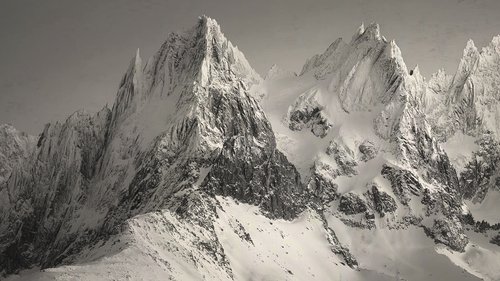
In 1923, André Sauvage produced his first film La Traversée du Grépon. Dedicated to mountaineering in the Mont Blanc massif, this documentary is a performance that earned him the recognition of his peers. André Sauvage and his companions decide to climb the Grépon, the best known of the Aiguilles de Chamonix, in the Mont Blanc Massif. Early in the morning, they cross the Mer de Glace, climb rocky peaks, abseil summits, cross crevasses, snowfields and long seracs. After sixteen hours of effort, the climbers return to the refuge. With his camera, Sauvage documents the difficult undertaking, also showing his strong passion for the mountains. "The deepest perception of mountains begins where intelligence ends." (A. Sauvage). Two long versions of the film have disappeared, one of 90 and the other of 51 minutes and only eight minutes are preserved.

On september 28th, 1903, the Urban Mountaineering Expedition, headed by Frank Ormiston-Smith, left Zermatt to attempt the conquest of the Matterhorn. On the 29th, the conquest was completed by the filming of the panorama from the actual summit of the mountain. The film consists of 20 scenes and illustrates the whole ascent from Zermatt through the Hornli Ridge. A copy of the film was found in Zermatt in 1953 and was was erroneously attributed to Frederick Burlingham and dated 1901. Since then, the film has been widely publicized as the first mountain film under the title of 'Cervino 1901', but this is incorrect.
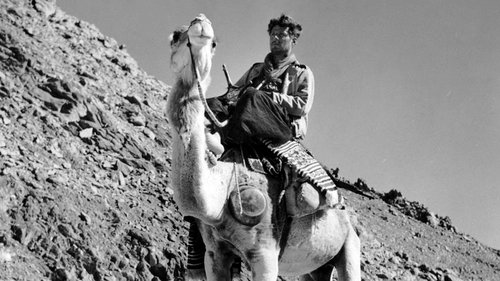
Roger Frison-Roche born in Paris in 1906 and moved to Chamonix at the age of 17. He was quickly adopted by local mountaineers and became the first guide in the Company not to have been born in the valley. He is also an insatiable explorer, in love with landscapes and peoples, having traveled from the Hoggar to the Sami camps in Lapland. And the author, among others, of the famous adventure novel Premier de Cordée! This documentary, made up of archive images and interviews, exposes the prolific life of a man who communicated his passion for the mountains by all possible means. A young journalist from Chamonix follows in the footsteps of Roger Frison-Roche. She meets people who knew him and others who followed in his footsteps: guides, filmmaker and author Philippe Claudel, a director, his family; on a trip to Lapland, Algeria, Chamonix.
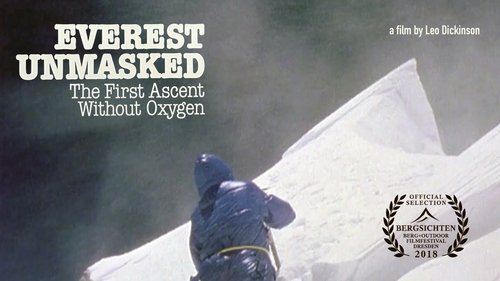
Record of the first ascent of Everest made without the use of oxygen equipment, made in May 1978 by Reinhold Messner and Peter Habeler. Could it be done? Would their blood vessels burst? Would they suffer brain damage leading to madness? Nobody was sure. Messner: 'I would never come here for trying Everest with oxygen. That is not a challenge for me.' A fascinating piece of history, well filmed by Leo Dickinson and Eric Jones (above the South Col Messner used a cine camera to continue the filming), featuring Messner and Habeler's thoughts. The film follows the usual sequence from Namche to Base Camp, through the Icefall, to Camps I, II and III. It also shows historical footage of the pioneering Mallory and Shipton expeditions.

The first ascent of the Matterhorn was made on July 14, 1865 by Edward Whymper, Francis Douglas, Charles Hudson, Douglas Hadow, Michel Croz and two guides from Zermatt, Peter Taugwalder father and son. Douglas, Hudson, Hadow and Croz are killed on the descent after Hadow slips and drags the other three men down the north face. Whymper and the two Taugwalders, who survive, are later accused of having cut the rope that connected them to the rest of the group so as not to be dragged into the fall, but the ensuing investigation finds no evidence of their guilt and they are acquitted. The Matterhorn is the last great peak in the Alps to be conquered and its ascent marks the end of the golden age of mountaineering. One hundred and fifty years later, a team undertakes the same expedition in order to unravel the mystery.
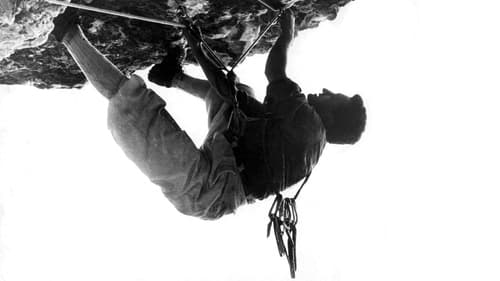
Georges Livanos, nicknamed the Greek but pure child of Marseille, amateur mountaineer, opened more than 500 routes in the Calanques, 40 in the Dolomites, and repeated many of the greatest routes in the Alps in the company of the best climbers of his time, d friends, and especially his wife Sonia. He is also the author of the classic "Beyond the vertical". This report follows for a day the legend, still 71 years old, of his apartment in the Marseille city in the Calanques. As a true Provençal, he speaks without filter of the exploits that made him famous, gives his opinion on modern climbing and on life in general: the portrait of a great climber and above all of a fascinating character with a sense of humor sharp.

History, advice and demonstrations of mountaineering in the Mont Blanc massif by the renowned guides of the National School of Ski and Mountaineering from Chamonix. The film starts with an historical summary illustrating the aspirations and methods that lead man to conquer the mountains. Armand Charlet teaches mountaineering techniques and takes his students to the field for glacier or rock exercises. Gaston Rebuffat makes demonstrations of particularly dangerous climbs. At altitude, people move in solitude, cold and silence, like circus acrobats without spectators, but nothing stops the modern mountaineer.